
Bio-inspired Autonomous Underwater Vehicles (AUVs) are robotic systems designed to mimic the movement, efficiency, and adaptability of marine animals. By studying fish, squid, turtles, and other aquatic organisms, engineers have created underwater robots that can swim with minimal energy, navigate complex environments, and operate silently- ideal for ecological surveys, monitoring sensitive habitats, and military applications.
Key Bio-Inspired AUV Models
RoboTuna (MIT, USA)
- Inspired by the tuna’s swimming mechanics, RoboTuna replicates the lateral undulation of fish tails.
- Focus: Efficient propulsion and maneuverability.
- Features: Flexible tail fin, modular design, and studies on hydrodynamics for energy-efficient swimming.
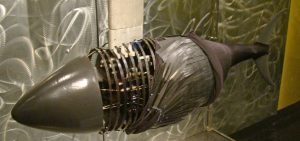 Fig. 1. Robotuna on display at the MIT Museum.
RoboPike / RoboRay (Various European Institutions)
- RoboRay mimics stingrays with pectoral fin undulations for smooth, silent movement.
- RoboPike imitates eel-like undulation for slender, snake-like navigation through narrow spaces.
- Applications: Underwater environmental monitoring and inspection of tight seabed areas.
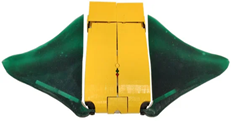
Fig. 2. A Bioinspired Cownose Ray Robot for Seabed Exploration.
BIOMIMETIC ROBOTIC FISH (Harvard Wyss Institute, USA)
- Modeled after different fish species for high agility in tight aquatic environments.
- Features: Soft-body fins, autonomous navigation, and energy-efficient propulsion.
- Applications: Studying marine life without disturbing habitats.
Squid-Inspired Soft AUVs (Japan / Europe)
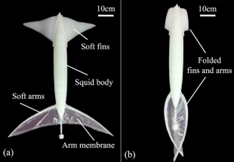
- Soft-bodied robots replicate squid jet propulsion, enabling bursts of speed and hovering.
- Advantages: High agility, stealth, and minimal turbulence for sensitive ecosystems.
Gliding Jellyfish AUVs
- Mimics jellyfish pulsating movement to minimize energy use.
- Often used for long-duration oceanographic missions in deep-sea or midwater zones.
Advantages of Bio-Inspired Designs
- Reduced energy consumption compared to traditional propeller-driven AUVs.
- Enhanced maneuverability in complex environments.
- Low acoustic signature, ideal for ecological and defense applications.
- Flexibility for tasks in coral reefs, underwater caves, or fragile ecosystems.
Bio-inspired AUVs are bridging robotics and biology, providing machines capable of exploring the ocean as efficiently as marine animals themselves, opening new possibilities for research, monitoring, and disaster response .