

Did you know that we have mapped over 99% of the surface of Mars and 98.2% of the Moon, but we have only mapped about 27.3% of our own ocean floor? It is a striking irony of modern science that our maps of planets millions of miles away are far more detailed than those of the world hidden beneath our own waves. While we often see space as the ultimate unexplored place, the deep ocean is an extremely harsh high-pressure environment that can destroy any technology we send down. Here is why “Inner Space” remains the ultimate test for modern engineering.
1. The Crushing Weight: Surviving Extreme Pressure
The main challenge for deep-sea technology is hydrostatic pressure. While space has almost no pressure, the ocean is the opposite: the deeper we go, the greater the pressure on the machines. At every 10-meter increase in depth the pressure rises by one full atmosphere. By the time a craft reaches the deepest parts of the ocean, the force on its structure is comparable to an elephant or a heavy SUV pressing on every square inch. To withstand this, engineers use very strong materials such as titanium or thick-walled synthetics. Even a small air pocket trapped inside the machine can cause an immediate and catastrophic failure under the immense water pressure.
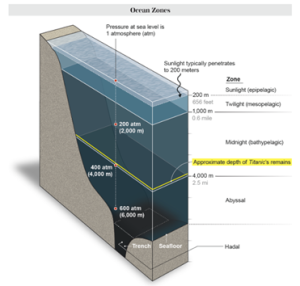
Credit: Jen Christiansen, modified from “How the Ocean Sustains Complex Life,” by Mark Fischetti, Kelly J. Benoit-Bird, Skye Morét and Jen Christiansen, in Scientific American; August 2022
2. The Communication Barrier: Why Radio Waves Fail
NASA can stay in contact with probes across the solar system because radio waves travel through a vacuum effortlessly. However the moment a signal enters the ocean the saltwater which acts as a conductor absorbs electromagnetic energy within just a few meters. This physical reality makes wireless “remote control” impossible in the deep. To solve this, scientists rely on a “tether” which is a long reinforced cable that links the robot to a surface vessel. This lifeline provides the electricity needed for the motors and transmits high-definition video back to the operators.
3. The Navigation Struggle: Moving Without GPS
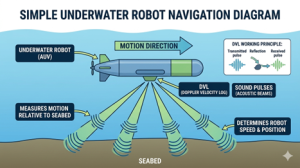
We rely on GPS for almost everything on land yet satellite signals cannot pass through water. Once a robot dives it is cut off from any global positioning system. In space probes can use the stars to find their direction but the deep ocean has no landmarks or satellite signals. Instead these machines must use “dead reckoning” assisted by sensors like the Doppler Velocity Log (DVL). This technology calculates speed and direction by bouncing sound waves off the seafloor. It is a delicate way to navigate and a small mistake can leave a robot completely lost in the dark ocean.
4. The Darkness Problem: Seeing with Sound
Sunlight disappears very quickly as we descend and is gone entirely by the 1,000-meter mark, a region often called the “Midnight Zone.” While deep-sea robots carry powerful LED lights they can usually see only a few meters ahead because the water is often filled with floating particles. When bright lights hit this “marine snow” they create a glare called backscatter, similar to using high beams in fog. To properly map the area robots use SONAR. They send out sound pulses and measure the echoes to create a 3D digital map of their surroundings, navigating more like bats using sound than humans using sight.
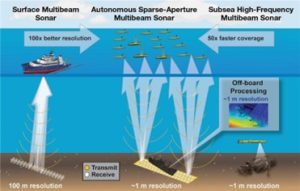
The autonomous sparse-aperture array (center) could map at 100 times the resolution of a surface vessel (left) and 50 times the coverage rate of an underwater vehicle (right). Credits: Image courtesy of Lincoln Laboratory.
5. The Chemical Attack: Fighting Saltwater Corrosion
Outer space is a sterile and empty void where a satellite can remain intact for decades. The ocean, by contrast, is a highly corrosive environment that gradually damages anything placed in it. Saltwater can corrode steel frames and harm sensitive electronic sensors. To protect these machines, engineers use “sacrificial anodes” which are pieces of metal that corrode instead of the robot’s main body. They also use specialized seals and oil-filled chambers to keep internal electronics safe from water. In the deepest parts of the ocean the environment continuously exposes these tools to corrosion.
Even though the ocean is a harsh environment for technology, every successful mission is a significant achievement for science. We don’t send these machines into the deep ocean just to demonstrate technical skill. We do it because we are committed to studying and protecting our planet. These robots act as our representatives, allowing us to discover new life, protect coral reefs and monitor the health of the global climate. The deep sea may be cold and dark, but every time a robot switches on its lights it brings new insights and hope. We are gradually uncovering the mysteries of the deep, one dive at a time.