

Beneath the sunlit surface of the ocean lies a world humanity has barely touched. Crushing pressures, absolute darkness, and near-freezing temperatures make the deep sea more alien than the surface of Mars — and yet it covers over half of our planet. For centuries it was unreachable. Then engineers began building machines that could go where we could not. This is the story of how underwater robots changed our understanding of Earth itself.
A Brief History of Underwater Robotics
The story begins in the early 1950s, when the U.S. Navy needed to recover equipment lost at depths too dangerous for divers. Their answer — CURV, the Cable-controlled Underwater Recovery Vehicle — was one of the first unmanned underwater machines. In 1966 it retrieved a lost hydrogen bomb off the coast of Spain, proving robots could perform critical work in the deep ocean. By the 1970s and 80s, the offshore oil industry had become the field’s greatest investor, deploying Remotely Operated Vehicles (ROVs) to inspect pipelines and seabed infrastructure. Piloted in real time from a surface ship, ROVs carried high-definition cameras, sonar, and mechanical arms precise enough for delicate operations — and they remain the backbone of deep sea work today. Then in 1985, an ROV named Argo located the wreck of the RMS Titanic at 3,800 metres depth, and the world finally grasped what these machines could do. Alongside ROVs, Autonomous Underwater Vehicles (AUVs) emerged — untethered robots that dive alone on pre-programmed missions for many hours, covering vast stretches of the seafloor. Where ROVs excel at precision and real-time response, AUVs excel at endurance and coverage. Together, they form the twin pillars of modern deep sea exploration.
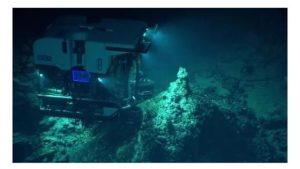 | 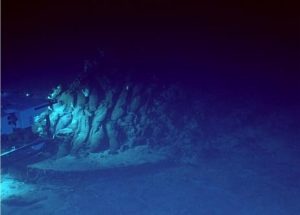 |
Fig. 1 — An ROV illuminates a hydrothermal vent structure on the deep seafloor. ROVs are piloted live from surface ships. Image: NOAA. | Fig. 2 — ROV Deep Discoverer photographs a small volcanic pillow mound, Voyage to the Ridge 2022. Image: NOAA Ocean Exploration. |
Descending into the Mariana Trench
The Mariana Trench, located east of the Philippines, is the deepest place on Earth. Its lowest point — the Challenger Deep — plunges to nearly 11,000 metres, deeper than Mount Everest is tall, and 120 times larger in volume than the Grand Canyon. Pressure at the bottom exceeds 1,000 times that at the surface, making it impossible for any unprotected human to survive there. In 2016, NOAA’s ship Okeanos Explorer deployed ROVs into the trench, capturing footage that astonished scientists worldwide. The trench was found to host mud volcanoes, pools of liquid sulfur, and organisms surviving entirely on chemical energy from hydrothermal vents. The region’s ecological significance was already recognised — in January 2009, the United States formally established the Marianas Trench Marine National Monument to protect it.
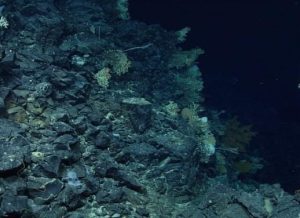 | 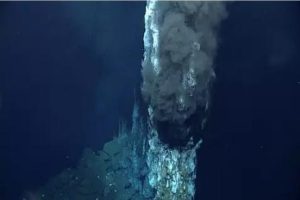 |
Fig. 3 — Rocky Ridge deep inside the Mariana Trench, with corals and sponges colonising the dark volcanic rock. Image: NOAA / FWS. | Fig. 4 — Hydrothermal vents spill black chemical-rich plumes in the Mariana Trench depths during a 2016 NOAA exploration. Image: NOAA / FWS. |
Hydrothermal Vents: Life Without Sunlight
Among the most dramatic discoveries enabled by underwater robots are hydrothermal vents — cracks in the ocean floor where superheated, mineral-rich water erupts from the Earth’s interior at over 400°C. Entire ecosystems thrive around them in total darkness, sustained by chemical energy rather than sunlight. Before ROVs gave us eyes on the deep seafloor, we had no idea these ecosystems existed. They are now considered among the most important biological discoveries of the twentieth century, fundamentally changing scientific thinking about where life can survive — and where it might exist on other worlds.
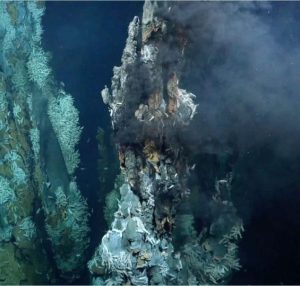
Fig. 5 — High-temperature hydrothermal vent field at Puy des Folles Seamount, Mid-Atlantic Ridge (~2,000m depth), surrounded by dense tube worm colonies. Image: Schmidt Ocean Institute / NOAA.
New Species, New Science
The 2016 NOAA dives into the Mariana Trench yielded biological discoveries that stunned scientists. A shark was filmed in waters now identified as having the highest shark density anywhere in the Pacific Ocean. Even more remarkably, a ghost fish from the Aphyonidae family was photographed alive for the very first time in recorded history — a species previously known only from dead specimens. Both discoveries were made possible entirely because ROVs could reach a place no human had ever been.
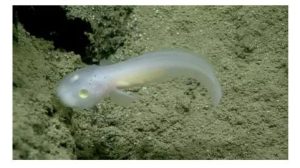 | 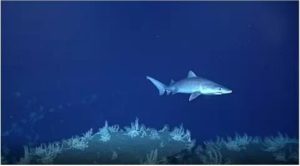 |
Fig. 6 — A ghost fish (Aphyonidae) photographed alive for the first time ever during a 2016 Mariana Trench dive by NOAA. | Fig. 7 — A shark swims within the Mariana Trench as seen from NOAA ship Okeanos Explorer submersible, 2016. Image: NOAA / FWS. |
The Ocean’s Story Is Only Beginning
What began as a military salvage tool has become humanity’s most powerful instrument for understanding our own planet. ROVs bring a precise, responsive hand to the deep — operating equipment, collecting samples, and reacting in real time to what they find. AUVs extend our reach further still, autonomously mapping vast tracts of the ocean floor on missions that would take human divers years to complete. Together, they have revealed volcanic mounds, rocky ridges teeming with life, black smoker vents fuelling entire ecosystems, and species never before seen alive by human eyes. The deep ocean regulates our climate, sustains life, and holds secrets we are only beginning to uncover. In the great story of exploration, the deep sea is the last unwritten chapter — and robots are the ones holding the pen.
References & Image Credits
- NOAA Ocean Exploration — oceanexplorer.noaa.gov | Voyage to the Ridge 2022 Expedition
- U.S. Fish & Wildlife Service — fws.gov/story/2023-02/mariana-trench-photos-and-videos
- Schmidt Ocean Institute — schmidtocean.org | In Search of Hydrothermal Lost Cities Expedition
All photographs are public domain courtesy of NOAA Ocean Exploration, U.S. Fish & Wildlife Service, and Schmidt Ocean Institute.